
When your pet starts getting ill it can be hard to tell how severe the symptoms are.
It is always a good idea to call your Primary Care Veterinarian to discuss the symptoms you are seeing at home and schedule an appointment for a full exam, but in the mean time this can help you understand how urgent your pets condition may be.
Mild (Green):
- Itching / Scratching
- Chronic weight loss
- Chronic condition that is well managed with no recent changes (Cushings, Diabetes, Allergies, Heart Murmur)
- Hair loss
- Redness on the skin or around the eyes and ears
- A single short seizure, less than a minute, with no recurrent episodes
- Mild vomiting or diarrhea, once or twice a day, with no changes to your pets behavior or activity level
- Mild cough, only a few times a day, with no changes to your pets behavior or activity level
- Lumps or bump developing over weeks - months
Whats the next step?
- Give the clinic a call at (928)315-6600. We will get you scheduled for an appointment for our next available spot or whenever is convenient for your schedule. If your pet is a current patient, we may be able to offer some home remedies to try prior to your visit depending on what you describe.
Moderate (Yellow):
- Vomiting or diarrhea, more than 2 times a day or blood can be seen
- Straining to pass a bowel movement
- Multiple coughs in a row, with no difficulty breathing or changes to activity level
- Witnessed ingestion of non-edible material (wrappers, plastic, string, toys), with no changes to your pets behavior or activity level
- Small wounds or lacerations that are not bleeding
- Broken toe nails
- Limping but still weight baring
- Squinting or swelling of the eye
Whats the next step?
- Give the clinic a call at (928)315-6600, and we will get your pet worked into the schedule as quickly as possible. We try to get your pet an appointment within 1-3 days of your call.
Urgent (Orange):
- Vomiting or Diarrhea more than 5 times in a day, with or without blood visible
- Complete lack of bowel movements for more than a 24 hour period
- Sudden changes or audible sound while breathing (wheezing, gurgling, whistling)
- Witnessed ingestion of non-edible material (wrappers, plastic, string, toys), and changes to your pets behavior
- Wounds with uncontrolled bleeding
- Multiple seizures in a day, but none lasting longer than 2 minutes
- Sudden weakness while walking or trying to stand
- Non weight baring on a leg
- Straining to urinate in dogs, and female cats
- Female dog or cat that is currently nursing a litter and seems suddenly weak or unable to stand
- Eating a toxic substance, please call the Pet Poison Helpline at (855)764-7661 while getting your pet into a veterinary clinic
Whats the next step?
- Please call the clinic at (928)315-6600. We reserve 2 slots everyday for urgent care appointments, and we try to ensure all urgent cases are seen as quickly as possible. We may refer you to a larger emergency veterinary hospital depending on your pets condition.
Emergent (Red):
- Male cats straining to urinate
- Sudden respiratory distress or blocked airways
- Large volumes of blood loss
- Active seizures that are not stopping or are continuing longer than 3 minutes
- Sudden swelling of the abdomen
- Sudden inability to stand or walk
- A puppy or kitten that is unable to eat or refusing to eat for more than 8 hours
- Envenomation or snake bites
- Hypothermia, or body temperatures lower than 96 degrees
- Hyperthermia, or body temperatures higher than 105 degrees
- Prolapsed eyes
- Organs outside of the body cavity
- A pregnant female in active labor that is unable to produce a puppy/kitten in more than 2 hours
Whats the next step?
- These conditions are life threatening and require immediate attention or emergency surgery. Please seek your nearest emergency veterinary hospital. Always call ahead so that staff can be prepared for your arrival and start helping your pet as soon as possible. If during our hours of operation, we will do everything possible to stabilize your pet, but your pet may need on-going care that could require referral to a larger emergency hospital.
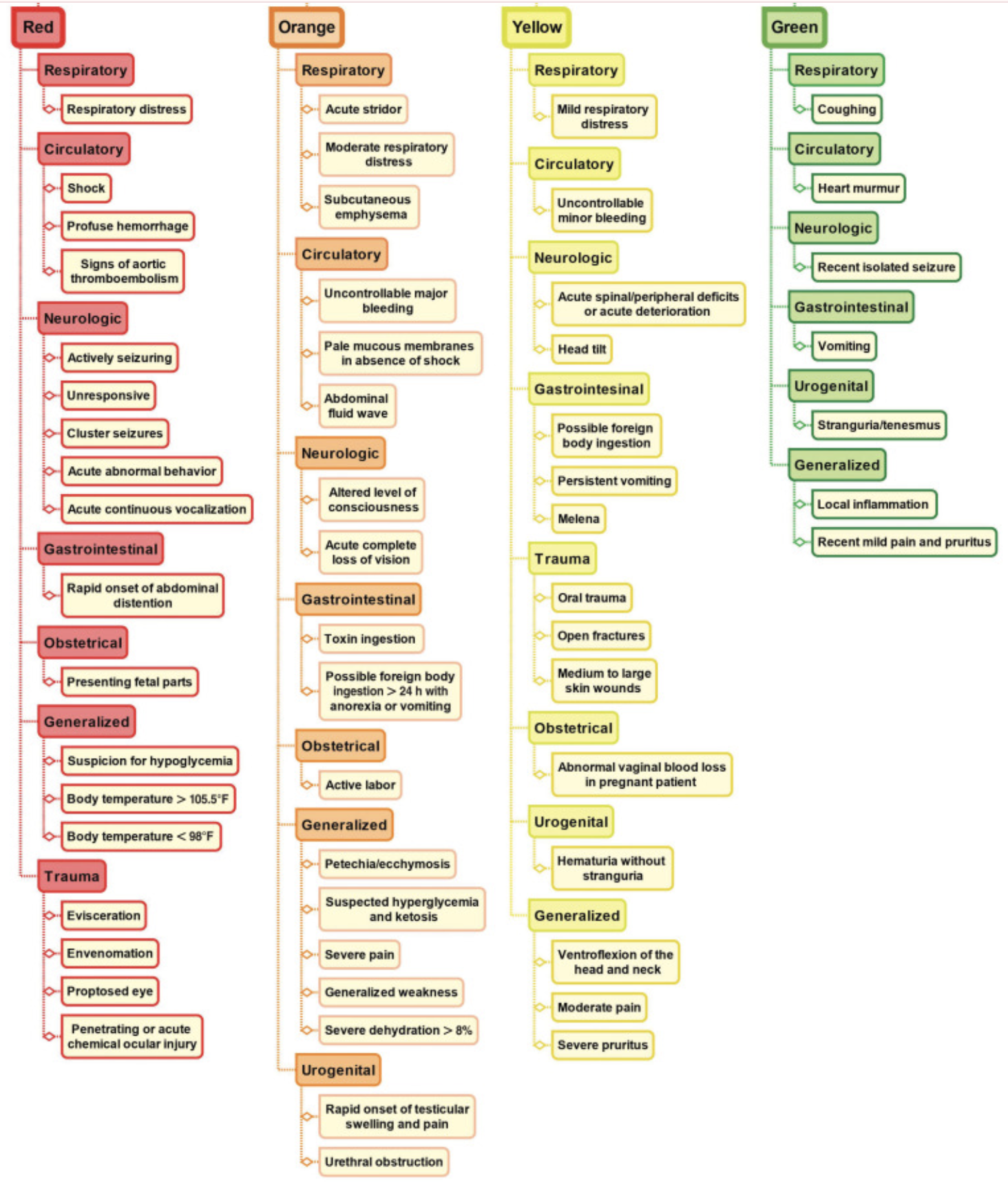
Thomovsky E, Ilie L. Basic triage in dogs and cats: Part I. Can Vet J. 2024 Feb;65(2):162-172. PMID: 38304479; PMCID: PMC10783570.